Nordglade / Experiment 04
Six overdue invoices. Three different next steps.
The recording
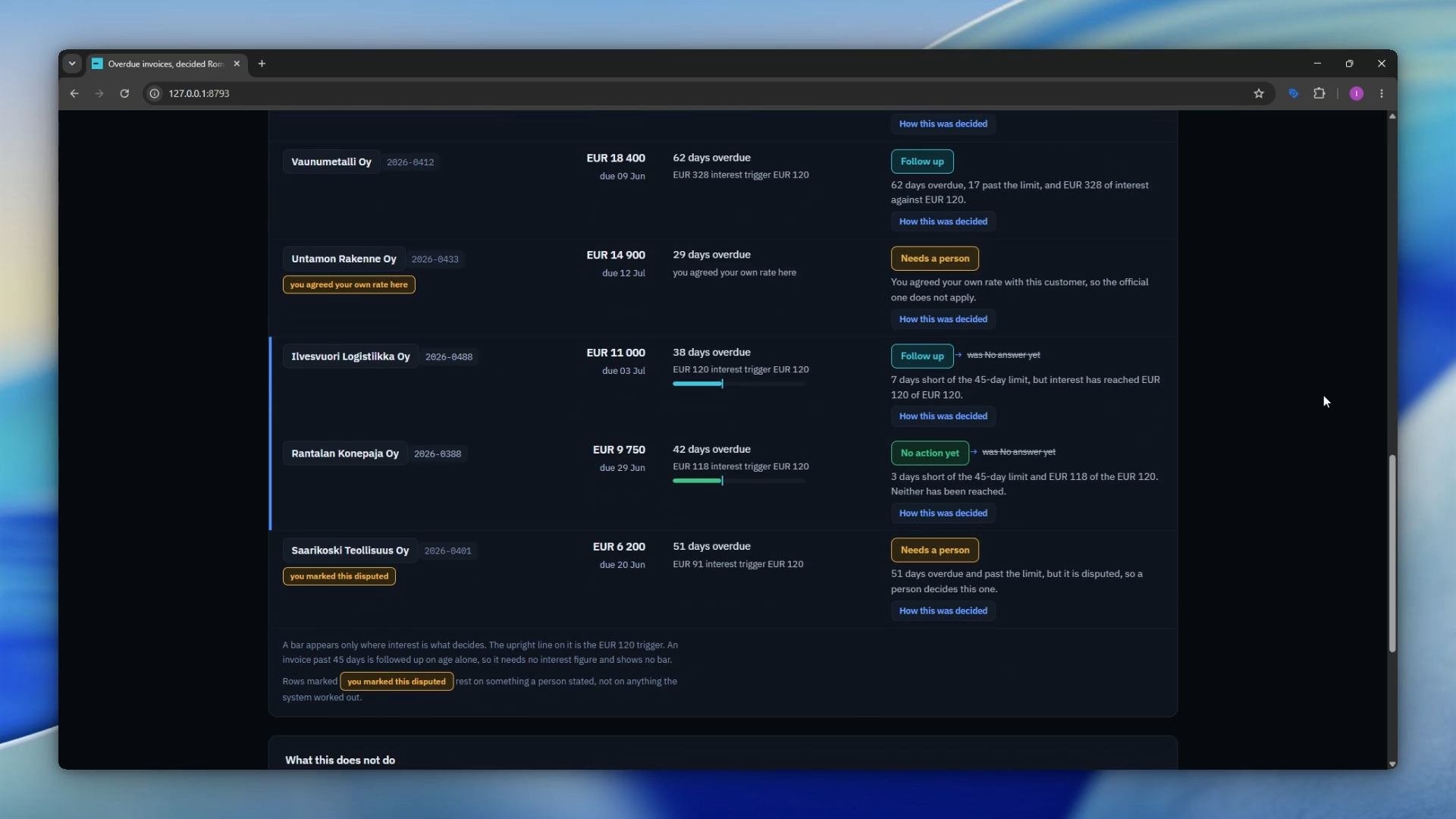
Paused at 25 sEvery company, customer, invoice and dispute here is fictional. Romuvirta Oy has six invoices past their due date and EUR 82 350 outstanding across them. The check reads them from a database and applies two limits the company set: 45 days past due and EUR 120 of accrued interest. It then says what to do with each invoice and why. See it full size.
Try it
The public demo uses the same six fictional invoices and requires no login. The database-connected version is not public.
Where the line falls
Four of the six invoices received a clear next step from the company’s policy. Two were left for a person.
The limits are 45 days past due and EUR 120 of accrued interest, and crossing either one is enough to flag an invoice for follow-up. Looking only at age would miss an invoice that had already crossed the interest threshold.
The record
Four questionsWhat it reads
For each invoice, the check reads the amount, the due date, and anything a person has recorded against it: that it is disputed, or that a different interest rate was agreed with that customer.
Those invoice fields can come from a spreadsheet, accounting software or an ERP. The calculation also needs the applicable statutory rate. When the contract type is missing, a person must confirm it first.
There is no AI in this. It is arithmetic against a rule someone wrote down.
What it decides
It checks each invoice against both limits and shows which fact produced the result.
One invoice is 38 days overdue, short of the 45-day limit, and is marked for follow-up because its interest has reached EUR 120. Another is 42 days overdue, older, and is left alone because its interest stands at EUR 118.
A follow-up result is a recommendation. The check sends nothing.
Where it stops
It stops for three reasons.
Two invoices worth EUR 20 750 cannot be decided at all until someone confirms whether these are commercial contracts. The statutory interest rate depends on whether the contract is commercial, and both of these invoices turn on whether their interest has reached EUR 120. That is a fact about an agreement, not present in the supplied record, so the check will not assume it.
One invoice worth EUR 6 200 is 51 days overdue, but is left to a person because it was marked disputed.
Another invoice, worth EUR 14 900, has a separately agreed interest rate that is not included in the supplied record. The check therefore leaves it to a person instead of applying the published rate.
What this does not prove
It does not rank the invoices, and nothing here says which invoice to deal with first. It makes no judgement about whether a dispute is valid or a payment term lawful.
It has not been tested against a real company’s records, so this demonstration is not proof that it is ready for day-to-day use.
What I take from it
Author's noteSoftware can apply a written rule invoice by invoice. When it lacks a required fact or reaches an exception reserved for a person, it stops rather than guessing. Guessing the contract type here would have produced six confident answers, with nothing to show which two rested on the guess.
The practical result is that a person can focus on the invoices the recorded policy cannot settle.